
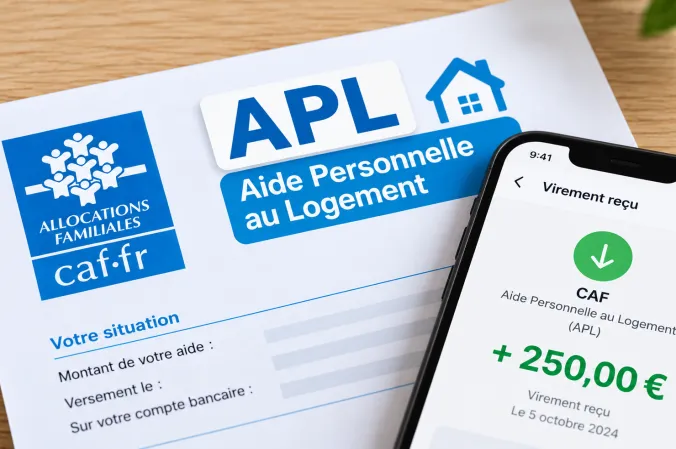


Housing aid in a Paris flatshare: APL and CAF explained
- Yes, flatmates can receive French housing aid: each one files their own claim, provided their name appears on the lease.
- The aid is computed on your share of the rent, not the full amount — and CAF applies a flatmate ceiling set at 75 % of a solo tenant’s.
- APL if the home is state-conventioned, ALS otherwise: CAF decides which one, and the application form is identical.
- Students: receiving the aid removes you from your parents’ CAF file — run the numbers on both sides before choosing.
- Everything happens online at caf.fr: simulate first, apply as soon as you move in, lease and bank details at hand.
Paris rent weighs heavily even split three ways — and many flatmates leave money on the table every month simply because they never filed. The rule is on your side: sharing a flat does not prevent you from receiving APL or ALS, each for your own share. Here is how the right opens, how the amount is worked out, and the two traps that cost real money.
Can flatmates receive housing aid at all?
Yes — and it is an individual right. Any flatmate whose name appears on the lease (the joint contract or an individual one) can file a claim, as long as the home is their main residence — occupied at least eight months a year — and is not rented from a family member. A roommate already receiving aid takes nothing away from yours: every file stands on its own.
APL or ALS: the home decides, not you
Strictly speaking, APL applies to conventioned housing — homes bound to the State by an agreement, which is uncommon in the Paris private market. Most flatmates therefore receive ALS, the social housing allowance, which plays the same role for non-conventioned homes. In practice the distinction changes nothing on your side: you fill in one single application and the caisse assigns whichever aid matches your case. The two never stack.
The calculation: your share and the flatmate ceiling
CAF does not look at the flat’s total rent but at what you actually pay: under a joint lease, the rent divided by the number of occupants; under individual leases, the figure on your own contract. That share is then measured against a specific cap: for flatmates it stands at 75 % of the ceiling applied to a solo tenant (article D.823-18 of the French housing code). Above it, extra rent no longer raises the aid. Your income counts too: the caisse uses your last twelve months of earnings, automatically refreshed every quarter — so a change of situation shows up quickly, in either direction.
Students: check your parents’ file before applying
The classic trap: the moment a student receives housing aid, they stop counting as a dependent child in their parents’ CAF file, and the family may lose part of its benefits. Depending on the case, what you gain on one side can be smaller than what the household loses on the other. The right reflex: simulate both sides — yours on caf.fr, your parents’ on their own account — and decide with the figures in front of you.
The application, step by step
- Before signing: run your future rent share through the caf.fr simulator — three minutes, instant estimate.
- On move-in day: file online with the lease (or your individual one), your bank details and your allocataire number if you already have one.
- The calendar: entitlement opens the month after you move in — filing early avoids losing monthly payments, as the aid is not paid retroactively beyond that.
- During the lease: report every change — a departing flatmate, a new job, moving in as a couple — and the caisse recalculates.
For landlords: an asset that fills rooms
Housing aid reassures the owner too: it strengthens serious applicants’ budgets, and in some cases can be paid straight to the landlord, who deducts it from the rent. Saying in your listing that the home qualifies helps candidates project themselves — and your room for rent reaches a wider audience. On the seeker side, stating a budget already computed aid-included makes your profile stand out; to place your rent share before simulating, the rent barometer by district gives the going ranges.
FAQ — housing aid and flatshares in Paris
Does a joint lease reduce the aid?
No: it only changes the base. Under a joint lease with a solidarity clause, CAF takes the total rent divided by the number of listed occupants — the same logic for everyone, with no penalty attached to the solidarity itself.
Can an international student claim it?
Yes, with a valid residence permit and the same conditions as any applicant: name on the lease, main residence, a rent share actually paid. The claim is filed online, exactly like a French student’s.
We are a couple within the flatshare: two files?
No — a couple forms one household for the caisse, so one single file for both, based on the couple’s rent share. The other flatmates each keep their own separate claim.
What happens to the aid when a flatmate leaves?
Report the departure to the caisse straight away: under a joint lease everyone’s share changes, so the amounts do too. Declaring late ends in an overpayment to give back — the most common mistake in shared homes.
Does the money arrive from month one?
Entitlement starts the month after you move in, with the first payment following. Hence the point of filing right after the inventory of fixtures, documents ready, rather than once you feel settled.
French housing code (Code de la construction et de l’habitation), article D.823-18 — flatmate rent ceilings set at 75% of a solo tenant’s (scales updated by decree, latest dated 5 September 2025).
caf.fr — housing-aid conditions, simulator and online application.