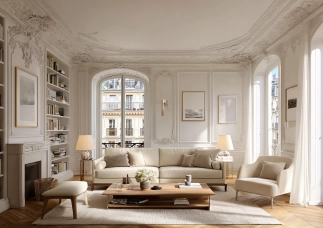
Two 6ths sit on top of each other. The one of café terraces, where visitors settle for an hour, camera across the shoulder. And the one upstairs, where family flats keep a spare bedroom and occupants who would welcome some company or help. This page is written for the second.
Is the 6th genuinely out of reach?
Less than you would think, provided you change currency: the 6th houses 40,432 inhabitants per the municipal population of the 2022 census (INSEE), with a large share of big, old flats — and therefore of unused bedrooms. What their owners want cannot be bought: time, presence, reliability.
The setting itself never loses value: the abbey of Saint-Germain-des-Prés, founded in the sixth century and among the oldest places of worship in Paris; the Luxembourg gardens as the local park; the Odéon and its arthouse cinemas; the market on rue de Buci. A district you cross on foot, river to garden, where residential life carries on above the shopfronts.
Three assumptions that close doors — wrongly?
'It's not my world': hosts want reliable help, not a pedigree. 'Nothing ever comes up there': offers exist, discreet and quickly taken. 'Those households need nothing': the district's high average age says precisely the opposite. All three crumble on inspection.
Behind each assumption stands a real host. A publisher's widow on rue de Condé who wants someone around in the evening and an arm for the stairs. A pair of overworked doctors near Assas who pass on the school walk and evening homework. A retired professor by the Luxembourg who trades his guest room for reading aloud and a few errands. The arrangement rests on a shared text that protects host and resident in equal measure — naming the duties, capping the weekly hours, dating the stay from start to finish, and spelling out the exit — with a signed copy for each.
No contacts in the 6th: what's your opening move?
Through the front door: a polished presentation, availability stated without vagueness, and a short note on why you, why this neighbourhood. Hosts in the 6th read carefully and reply sparingly — a generic message goes nowhere, a precise one earns a visit.
See colocationsparis.com. For getting around, line 4 serves Odéon and Saint-Germain-des-Prés, line 10 runs from Mabillon to Cluny, line 12 climbs rue de Rennes, and RER B waits at Luxembourg. The fifth shares its lecture halls, the seventh its ministries, the fourteenth its studios: three neighbouring pages worth keeping open.
Frequently asked questions
Can I work remotely from my room?
Usually yes, and many hosts even see it as a plus: a daytime presence is reassuring. Check two things before committing: the connection quality in the room itself, and whether your video calls fit the household's rhythm.
Is the kitchen shared, and the living room too?
In most households, yes — the exchange assumes shared living, not an isolated maid's room. The exact extent of that access (kitchen hours, private corners) is clarified at the visit and can go into the signed text if a point matters to you.
How long does it take to find a place in the 6th?
Count in weeks: offers are scarcer than in eastern Paris and hosts take their time choosing. The right strategy pairs patience with active watching — alerts always on, same-day replies, and a spotless profile from day one.
Do publishing and gallery hosts keep unusual schedules?
Some do — book fairs, openings, auction weeks — and that is often exactly why they need help: a presence at home while professional life runs late. If your own timetable is flexible, say so upfront; in this district it is a currency of its own.