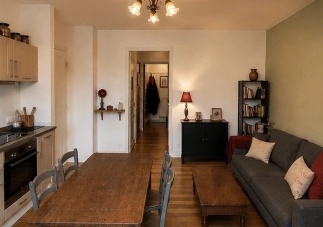
Walking back along rue Cler with the market basket, greeting the concierge, heading upstairs to help Madame R. sort her post before an evening class: that is housing for services in Paris 7, concretely. No rent changes hands — time given, a room received.
Why does Paris 7 hold so many rooms without occupants?
Because its flats are large and its households small: INSEE's 2022 municipal count puts Paris 7 at 48,196 residents, most of them housed in generous family apartments. Many hosts have lived alone since the children moved out — the spare rooms, meanwhile, never went anywhere.
The setting reads like an open-air museum: the Hôtel des Invalides, founded in 1670 for the kingdom's wounded soldiers, anchors the district under its gilded dome; the Musée d'Orsay fills the old railway station on the Seine; the Champ-de-Mars serves as a shared garden at the foot of the Eiffel Tower. In between runs a deeply residential fabric: the rue Cler market, the schools of the Gros-Caillou, the bookshops of Saint-Thomas-d'Aquin.
From listing to keys: how does a match come together?
In four stages spread over three to five weeks: the listing goes up, messages are exchanged, a meeting takes place in the flat, and a written agreement is signed — the reference document for the whole stay. Each stage filters out mismatches; by moving day, nothing is left to discover.
Week one: the listing appears — hoped-for services, pace, room — and the first applications arrive. Week two: the host answers the most precise messages, often with a video call. Week three: the visit — the room, the shared spaces, each side's habits. Week four: the written agreement is signed, recording the missions retained, the hours owed each week, the timetable of the stay and its exit clause — the reference document at the first doubt. Then come the keys.
What wins a room between Les Invalides and the Champ-de-Mars?
Three habits: switch on alerts for the Paris 7 section, keep a complete profile — time slots, languages, experience of helping — and reply within the day, mirroring the exact services requested. Offers in this district are scarce and hosts choose carefully: precision beats speed every time.
Meeting point: colocationsparis.com. For getting around, line 8 serves École Militaire and Invalides, line 12 runs from Solférino to rue du Bac, line 13 stops at Varenne, and RER C follows the Seine to the Musée d'Orsay. Publish your profile or your request today, then keep the neighbouring pages open: the sixth with its lecture halls, the eighth with its office towers, the fifteenth with its family addresses.
Frequently asked questions
Can two people apply together, as a couple or a pair?
Rare but not excluded: most rooms on offer suit one person, and the balance of the household remains the host's priority. Some Paris 7 listings explicitly welcome a couple — in that case, say so in your very first message, never after the visit.
Can the service cover computers and online paperwork?
Yes, and demand keeps growing: setting up a tablet, video calls with grandchildren, declarations handled online. Digital services are treated like any others: described in the listing, then written into the agreement.
What happens to the exchange when the host goes away?
The agreement covers it: depending on the household, hours are paused, carried over, or converted into looking after the home — plants, post, a reassuring presence. A long absence is discussed ahead of time; nothing should be settled orally on the doorstep.
Can I apply to several listings at the same time?
Yes — and it is even advisable in a district where each listing quickly draws several profiles: nothing binds you exclusively before signing. The one rule is to tell the other hosts as soon as you commit elsewhere, freeing the spot without keeping anyone waiting.