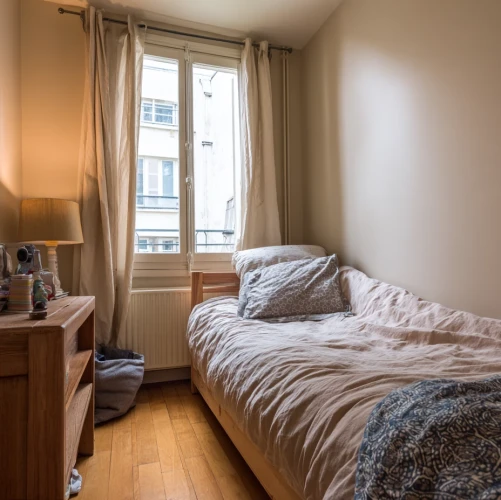
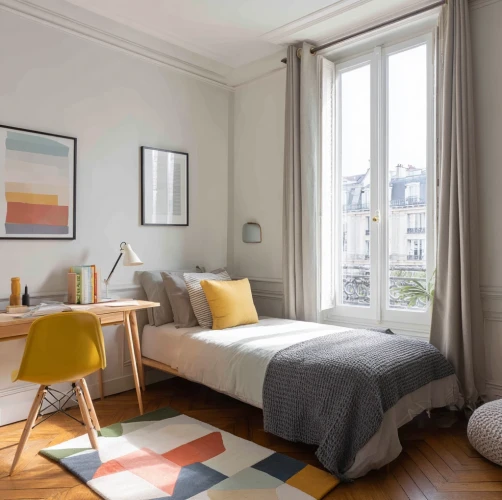
Step off the train, cross the forecourt, drop your bags a few streets away: few districts shorten the journey between arriving in Paris and the first evening at home like this one. The 10th runs on short distances, and housing for services replaces rent here with a few hours of weekly help to the household hosting you.
Why is the 10th an ideal gateway into Paris?
Because everything converges here: two international stations, eight metro lines and a dense residential fabric — 81,926 inhabitants according to INSEE's 2022 legal population count. Behind the tracks, the 10th remains a district of households, with rooms available for anyone bringing time rather than rent.
The setting surprises anyone who only knows the platforms: the banks of the Canal Saint-Martin, opened in 1825, line up footbridges and locks a few minutes from the tracks; the Marché Saint-Quentin feeds the Faubourg Saint-Denis; the streets of the Faubourg Saint-Martin keep their workshops. Transit on the surface, neighbourly once you step away from the stations.
A few weeks, a semester, a whole year: which duration for your stay?
Every length of stay can be found in the 10th, but they do not point to the same listings. A short stay for an assignment, a university semester, a move of a year or more: settle your horizon first, then filter the offers that accept it — duration is the first criterion hosts sort by.
For a few weeks — an internship, a cover period — target households after one-off support, through a convalescence or a relative's absence. For a semester, families run by the school calendar dominate: school pick-ups, homework, Wednesdays. For a year or more, older residents attached to their flat value the stability of one same presence.
Whatever duration you choose, the commitment takes one same form: a dated exchange charter, signed before moving in. It lists the tasks one by one, sets the weekly volume of hours, records the agreed length of stay and details the conditions for ending the arrangement, notice included. That document holds from first day to last.
How do you start the search between canal and stations?
Three moves: open the section dedicated to the 10th, state your length of stay in your profile from the outset, then answer the listings whose hours fit inside your real week. Local households detail their expectations there, tasks and time slots displayed from the first line.
Getting around is the district's strong suit: lines 4, 5 and 7 as a backbone, RER B, D and E at the two stations, the rest of the city fifteen minutes away. Head to colocationsparis.com. Create your profile, switch on alerts, and widen the net by one stop if needed: the ninth, eleventh and eighteenth arrondissement pages await.
Frequently asked questions
Can I claim housing benefit (APL)?
Not in the general case: APL exists to lighten a rent, and this formula involves none — the saving lies in the very absence of rent. When in doubt, a check with the CAF before moving in settles it.
Do I contribute to bills (electricity, Internet)?
The principle is accommodation with no rent and no bills: your weekly help is the only consideration. If a household wishes a one-off contribution, it must appear in the listing and then in the signed charter; failing that, nothing is owed.
What if something comes up one week?
A one-off hitch — an exam, illness — is handled through dialogue: warn the household as early as possible and offer to reschedule the slot. The charter can anticipate such cases; the essential: never leave an absence unexplained.
Will I be the only person hosted?
Most often, yes: the formula rests on trust placed in one identified person. Some large homes occasionally take in two residents with distinct missions; the listing must then say so, and the visit is the moment to ask about the household's make-up.