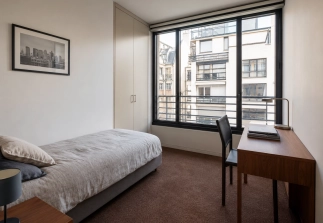
It all starts with an object: a set of keys on a kitchen table in the 15th. The gesture speaks of trust — you are opening your door to someone — and the counterpart is counted not in euros but in hours given. The exchange still has to be well prepared: that is where most candidates stumble.
Why does the 15th carry so many listings?
Sheer mass: 228,754 residents by the 2022 census count — no other arrondissement comes close. More households means more freed-up rooms, from the studios of Convention to the towers of the Front de Seine; and neighbourhood life calm enough for hosts to stay for decades.
The arrondissement stretches along rue de Vaugirard — the longest street in Paris, nearly 4.3 kilometres — which strings its former villages like beads: Commerce and its terraces, Convention and its schools, parc Georges-Brassens laid over the old slaughterhouses, Beaugrenelle and its riverside deck. So many micro-quarters, so many styles of listing.
Which mistakes cost you a good listing in the 15th?
Four come back constantly: replying in bulk without reading each listing; promising more hours than your week truly holds; skipping the preliminary meeting to move faster; and accepting a vague “we'll see once you're here” instead of requiring services spelled out in black and white before committing.
Each one is easy to fix. Read the listing twice and answer what it asks, not what you hope. Count your genuinely free hours, commutes included, before promising any. Always meet the household — a coffee is enough — before visiting, then visit before saying yes. And if a host stays vague about the expected services, treat that vagueness as an answer.
What then protects both sides is the framework agreement of the stay, signed ahead of move-in day: it sets down the entrusted room and the shared areas open to you, itemises the services one by one, sets their weekly maximum of hours and plans the exit — advance notice, keys handed back, a walk-through of the home. Nothing spoken replaces it; any addition is made in writing, dated and approved by both.
How do you tackle such a vast arrondissement?
Quarter by quarter, never as a block: pick two or three areas compatible with your daily commutes — Commerce, Convention, Beaugrenelle — and concentrate your applications there. In practice: colocationsparis.com. Filter, present your exact slots, and keep a written record of every exchange with the households you contact.
Métro lines 6, 8, 10 and 12 mesh the area, completed by the T3a to the south and the RER C along the Seine. To widen the comparison, the seventh, fourteenth and sixteenth arrondissement pages open other registers, from Les Invalides to Passy.
Frequently asked questions
Should I be wary of a listing without photos?
Not necessarily — some hosts are simply protective of their privacy — but ask for pictures before travelling, or suggest a video visit. A listing precise about the services yet discreet in images beats the opposite.
First contact: written message or phone call?
Writing first: it gives the household time to read your introduction and keeps a record of the exchange. The phone comes next, to set up the meeting — offer it in your message rather than calling unannounced.
Where should the first meeting take place?
Somewhere neutral and busy — a neighbourhood café does the job perfectly. The home visit comes after that first conversation, once both sides want to continue; it is more comfortable for everyone.
How is this different from an au pair placement?
Au pair is a specific regulated status, centred on childcare with pocket money and its own conditions. Here, the exchange concerns every host profile, with no payment: only a room against services capped in writing.